
ROPP closure
Roll-on pilfer-proof aluminium closure whose thread and lower tamper-evident band are formed around a compatible bottle finish during application.
Use the same technical language when discussing bottles, aluminium closures, capping heads, rollers, quality tests and acceptance. Exact definitions in a supplier drawing or standard take precedence over this practical guide.
Why terminology matters
ROPP projects combine bottle-making, closure supply, machine tooling, cap feeding, product quality and line integration. The same word can be used differently by different suppliers, so the project should cite drawings, part references and test methods rather than relying on an informal name alone.
This glossary explains common buying and engineering terms. It does not replace a dimensioned bottle finish, closure specification, machine drawing or competent risk assessment.
CETIE publishes recognised finish, cap, bottling and test data sheets for relevant aluminium screw-closure systems.
Closure and bottle
Roll-on pilfer-proof aluminium closure whose thread and lower tamper-evident band are formed around a compatible bottle finish during application.
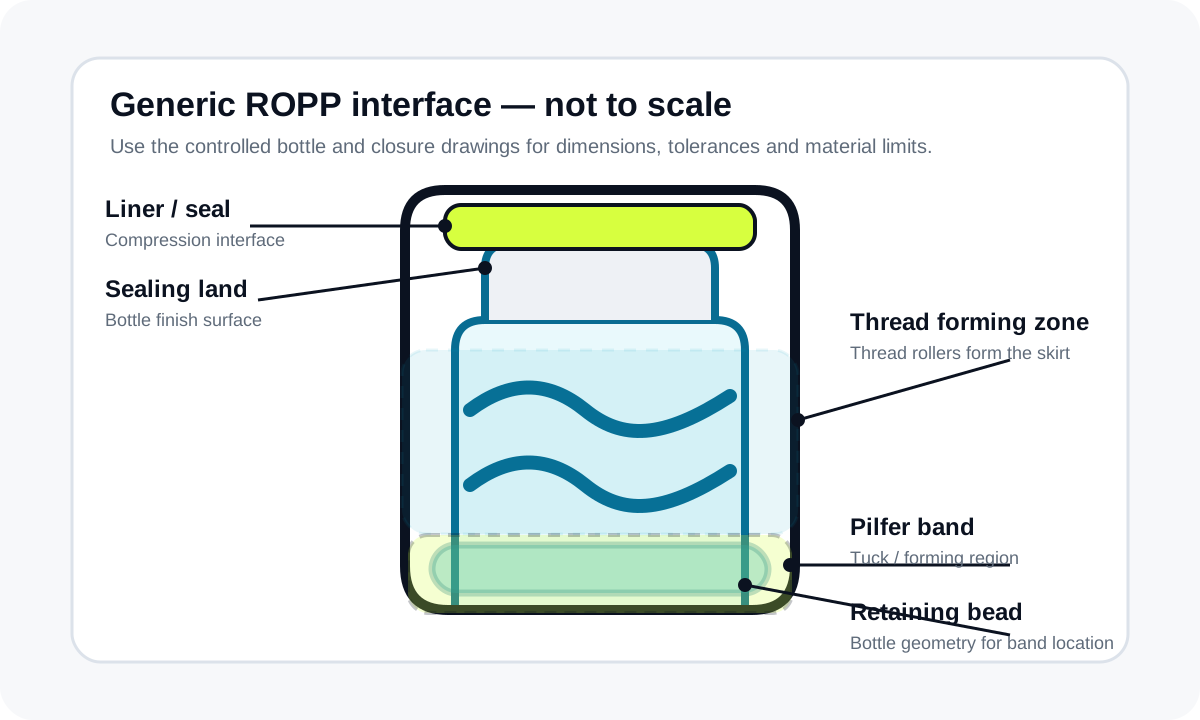
The aluminium body that is compressed and rolled. The lower skirt includes the region used to create the pilfer band.
The sealing material inside the cap. Construction, compression and compatibility are specified by the closure system and product requirement.
An additional component fitted in or under the closure or bottle neck. Its geometry and seating can affect cap placement, feed and trial requirements.
The controlled neck geometry that interfaces with the closure, including sealing surface, thread, transfer or retaining features and relevant diameters/heights.
The bottle surface contacted by the liner or sealing element. Damage or product contamination here can cause a leak even when the cap thread looks correct.
The beginning and end geometry of the bottle thread. These features influence how the aluminium is formed and how the closure opens.
The neck feature below which the pilfer band is formed or retained, depending on the closure system.
Controlled links within a tamper band that are intended to break during first opening. Their design and acceptance belong to the closure specification.
Machine and tooling
The assembly that controls cap compression and carries the forming rollers or related tooling. A multi-head machine has several heads that should be sampled individually.
The element that applies controlled vertical force to seat the cap and compress the liner before and during forming.
Profiled rollers that form the aluminium shell against the bottle thread. Profile, contact and setting must match the closure and finish.
Lower rollers that form the tamper band beneath the relevant bottle feature. The exact arrangement depends on the head and closure.
The platform, lift, pocket, starwheel or guide system that holds and centres the bottle against capping forces.
Format-specific parts such as starwheels, guides, cap tracks, chutes, pockets, supports or tooling required to run another bottle or cap.
The equipment that stores, separates, orients, buffers and transfers caps to the machine. The complete path must protect the closure.
The mechanism that releases or presents one cap at the correct time and position.
A record linking samples and settings to a specific head or station so local variation can be identified.
Quality and acceptance
| Term | Practical meaning | Control point |
|---|---|---|
| Opening torque | A measured turning effort during a defined opening method. It is not a complete seal test. | Instrument, grip, speed, conditioning, sample identity and reporting convention. |
| Leak / pressure test | An agreed method for evaluating sealing under defined pack conditions. | Product, fill, temperature, dwell, orientation, pressure/vacuum and pass rule. |
| First-off approval | Authorised acceptance of initial samples after set-up, start-up or changeover. | Retain sample, settings, date, operator and approver. |
| Operating window | The documented combination of settings and line conditions that produces accepted packs. | Actual packaging, speed, feeder, stops, inspection and rejects. |
| FAT | Factory acceptance test against the agreed machine scope before shipment. | Witness plan, packaging, functions, quality, timed run and deviations. |
| SAT | Site acceptance test after installation in the final production environment. | Utilities, connected line, current packaging, local procedures and handover. |
| Accepted output | Bottles that meet the agreed finished-pack definition, not merely machine cycles. | Run duration, stops, rejects, sampling and counting method. |
Use the glossary
Use the bottle-neck guide for pack geometry, the capping-head page for tooling, the quality-inspection guide for finished-pack checks and the FAT guide for machine release.
Buyer questions
No. Some closures are pre-threaded and tightened, while a ROPP shell is formed around a compatible bottle finish during capping. Confirm the closure drawing.
The terms are often used for the lower tamper-evident feature, but the exact construction and bridge design should be taken from the closure specification.
ROPP closures are formed by rollers, so the project should use the measurement names and methods defined by the closure supplier and quality plan rather than assuming screw-cap terminology transfers directly.
It is the controlled geometry at the bottle neck that interfaces with the closure, including sealing, thread and retaining features.
Send the bottle, closure, liner, insert and quality references so Lancing can review the complete ROPP interface.